
Inconel 625 Pipe Fittings
Inconel 625 Pipe Fittings ( UNS N06625 )
Inconel 625 Pipe Fittings are manufactured from a nickel-chromium-molybdenum-niobium alloy known for exceptional strength, corrosion resistance, and thermal stability. Renowned for its ability to withstand high temperatures, intense pressure, and highly corrosive environments, Inconel 625 is a preferred material for offshore, chemical, nuclear, and aerospace industries. The alloy provides remarkable resistance to pitting, crevice corrosion, chloride stress corrosion cracking, oxidation, and carburization, making it suitable for the harshest operating conditions.
Key Features
Outstanding Corrosion Resistance against seawater, acids, alkalis, and chloride environments.
High Strength Without Heat Treatment due to solid-solution strengthening by niobium and molybdenum.
Excellent Fatigue & Creep Resistance at elevated temperatures.
Superior Weldability with no risk of cracking or post-weld hardening.
Exceptional Oxidation Resistance up to 980°C.
High Versatility suitable for both low- and high-temperature applications.

Specification
| Specification | Details |
|---|---|
| Material | Inconel Alloy 625 |
| Standard | ASTM B366 / ASME SB366 |
| UNS Number | UNS N06625 |
| Werkstoff Nr. | 2.4856 |
| Manufacturing Type | Seamless / Welded / Fabricated |
| Size Range | ½” to 24” |
| Wall Thickness | SCH 5S to SCH XXS |
| Dimensions | ASME B16.9, B16.28, MSS-SP-43 |
| Type | Buttweld, Socket Weld, Threaded |
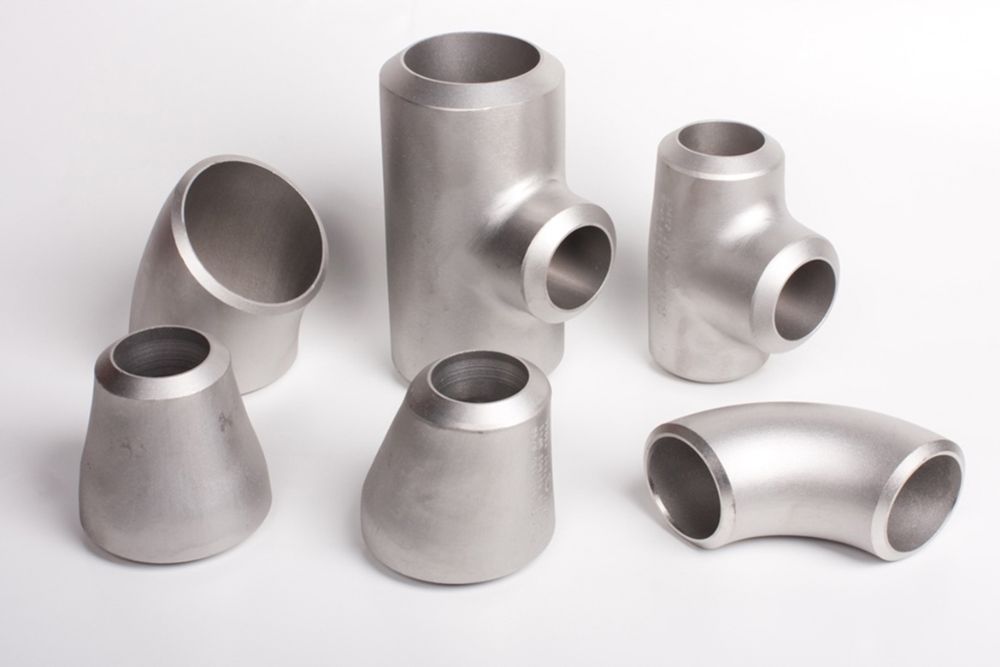
| Form | Elbows, Tees, Reducers, Caps, Stub Ends, Cross, Bends |
Equivalent Grades
| Standard | Equivalent Grade |
|---|---|
| UNS | N06625 |
| Werkstoff Nr. | 2.4856 |
| EN | NiCr22Mo9Nb |
| AFNOR | NC22DNb |
| BS | NA 21 |
Available Sizes
Buttweld Fittings: ½” to 24”
Socket Weld Fittings: ⅛” to 4”
Threaded Fittings: ⅛” to 4”
Custom sizes available as per client requirements.
Chemical Composition
| Element | % |
|---|---|
| Nickel (Ni) | ≥ 58.0 |
| Chromium (Cr) | 20.0 – 23.0 |
| Molybdenum (Mo) | 8.0 – 10.0 |
| Niobium + Tantalum (Nb+Ta) | 3.15 – 4.15 |
| Iron (Fe) | 5.0 max |
| Manganese (Mn) | 0.50 max |
| Carbon (C) | 0.10 max |
| Silicon (Si) | 0.50 max |
| Aluminum (Al) | 0.40 max |
| Titanium (Ti) | 0.40 max |
Mechanical Properties
| Property | Value |
|---|---|
| Tensile Strength | 827 MPa (min) |
| Yield Strength (0.2% Offset) | 414 MPa (min) |
| Elongation | 30% (min) |
| Hardness | 92 HRB (max) |
Physical Properties
| Property | Value |
|---|---|
| Density | 8.44 g/cm³ |
| Melting Point | 1290 – 1350°C |
| Thermal Conductivity | 9.8 W/m·K |
| Electrical Resistivity | 1.22 μΩ·m |
| Specific Heat | 410 J/kg·K |
Types of Inconel 625 Pipe Fittings
Buttweld Pipe Fittings
45° / 90° / 180° Elbow
Equal & Reducing Tee
Concentric & Eccentric Reducer
End Caps
Long / Short Stub Ends
Cross Fittings
Socket Weld Pipe Fittings
SW Elbow, Tee, Cross
SW Coupling, Half Coupling
SW Reducers
Threaded (NPT/BSP) Fittings
Threaded Elbow
Threaded Tee
Bushings, Plugs
Threaded Caps
Corrosion Resistance
Inconel 625 exhibits exceptional resistance to:
Pitting & crevice corrosion
Chloride-induced stress corrosion cracking
Seawater & marine environments
Acidic solutions: sulfuric, nitric, phosphoric
Oxidizing & reducing environments
High-temperature corrosion & carburization
Its high molybdenum content makes it ideal for aggressive chemical processing.
Heat Resistance
Excellent oxidation resistance up to 980°C
High creep and rupture strength
Suitable for high-temperature ducts, furnace parts, and combustion systems
Suitable for cryogenic temperatures as well
Heat Treatment
Inconel 625 is non-hardenable by heat treatment.
Softening or stress relieving performed at 980–1150°C followed by rapid cooling.
Annealed condition offers maximum ductility.
Welding
Inconel 625 demonstrates excellent weldability:
Compatible Welding Processes:
TIG (GTAW)
MIG (GMAW)
SMAW (Shielded Metal Arc Welding)
FCAW
Recommended Filler Metal:
ERNiCrMo-3 / Inconel 625 filler
No preheat or post-weld heat treatment usually required.
Fabrication
Good machinability and formability
Suitable for cutting, forming, bending, and forging
Hot working temperature: 1150°C – 900°C
Cold working increases hardness and precision tolerances
Applications
Offshore engineering & subsea equipment
Aerospace components
Chemical processing plants
Nuclear reactors
Heat exchangers & high-temperature piping
Marine engineering
Flare systems & combustion liners
Pollution control equipment