
Hastelloy X Flanges
Hastelloy X Flanges ( UNS N06002 ) Manufacturer & Supplier
Hastelloy X Flanges are engineered from a solid-solution nickel-chromium-iron-molybdenum alloy known for its exceptional strength and oxidation resistance at high temperatures. This alloy is widely used in gas turbine engines, industrial furnaces, petrochemical processing, and heat treatment equipment due to its stability and durability under extreme thermal conditions.
Designed to perform reliably in temperatures up to 1200°C, Hastelloy X Flanges offer excellent resistance to carburization, oxidation, and thermal fatigue. Their outstanding weldability and formability make them a preferred choice for demanding high-temperature industrial applications.
Key Features
Excellent strength and oxidation resistance up to 1200°C
Outstanding resistance to carburization and nitriding
Excellent high-temperature stability and thermal fatigue resistance
Superior mechanical strength and structural stability
Outstanding weldability using standard methods
Suitable for extreme heat, pressure, and corrosive environments
Long-lasting performance in furnaces, turbines, and chemical processing
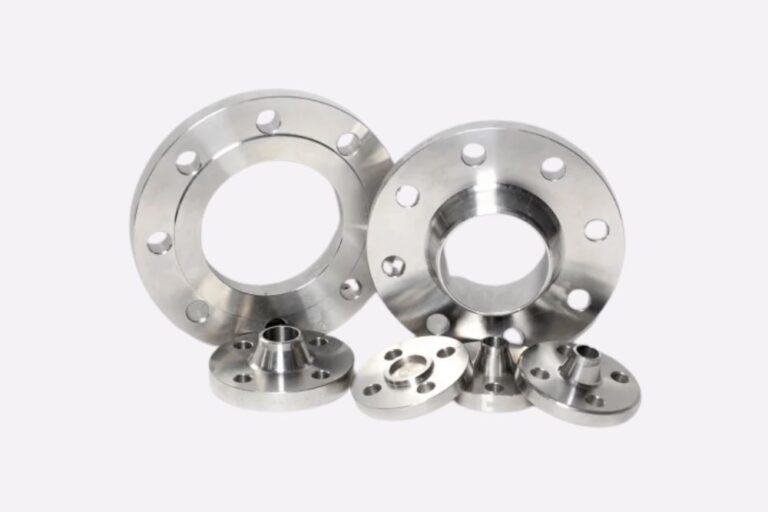
Specifications
| Specification | Details |
|---|---|
| Grade | Hastelloy X |
| UNS | N06002 |
| Werkstoff Nr. | 2.4665 |
| Standards | ASTM B564, ASME SB564 |
| Flange Types | WNRF, SORF, BLRF, SWRF, Threaded, Lap Joint, Orifice, Long Weld Neck |
| Size Range | ½” to 48” |
| Pressure Class | 150#, 300#, 600#, 900#, 1500#, 2500# |
| Face Type | RF / RTJ / FF |
| Form | Forged, Plate, CNC Machined |
Equivalent Grades
| Standard | Grade |
|---|---|
| UNS | N06002 |
| WNR | 2.4665 |
| Trade Name | Hastelloy X |
Available Sizes
Flange Size: ½” to 48″
Pressure Rating: 150# – 2500#
Custom sizes available on request
Chemical Composition
| Element | Percentage (%) |
|---|---|
| Nickel (Ni) | Balance |
| Chromium (Cr) | 20.5 – 23 |
| Iron (Fe) | 17 – 20 |
| Molybdenum (Mo) | 8 – 10 |
| Cobalt (Co) | 0.5 – 2.5 |
| Tungsten (W) | 0.2 – 1.0 |
| Carbon (C) | 0.05 – 0.15 |
| Manganese (Mn) | 1 max |
| Silicon (Si) | 1 max |
| Sulfur (S) | 0.015 max |
| Phosphorus (P) | 0.04 max |
Mechanical Properties
| Property | Value |
|---|---|
| Tensile Strength | 690 MPa (min) |
| Yield Strength (0.2% offset) | 275 MPa (min) |
| Elongation | 40% (min) |
| Hardness | 88 HRB max |
Physical Properties
| Property | Value |
|---|---|
| Density | 8.22 g/cm³ |
| Melting Point | 1260–1340°C |
| Thermal Conductivity | 10.4 W/m·K |
| Specific Heat | 450 J/kg·K |
| Electrical Resistivity | 1.28 μΩ·m |
Types of Hastelloy X Flanges
Weld Neck Flanges (WNRF)
Slip On Flanges (SORF)
Blind Flanges (BLRF)
Threaded Flanges
Socket Weld Flanges
Long Weld Neck Flanges
Lap Joint Flanges
Orifice Flanges
Spectacle Blind Flanges
Reducing Flanges
Corrosion Resistance
Hastelloy X Flanges offer moderate corrosion resistance and are particularly known for:
Excellent oxidation resistance up to 1200°C
Good resistance to carburization
Superior resistance to high-temperature corrosion & sulfidation
Suitable for furnace atmospheres, hydrocarbons & combustion gases
Not recommended for highly reducing acid environments
Heat Resistance
Outstanding heat resistance up to 1200°C
Excellent creep strength at elevated temperatures
Resists thermal fatigue and cyclic heating
Suitable for extreme heat zones in aerospace and furnace components
Heat Treatment
Solution Annealing: 1175°C – 1205°C
Water quench or rapid cooling
Stress-relieving recommended after heavy forming
Heat treatment enhances ductility and high-temperature corrosion resistance
Welding
Hastelloy X is one of the most weldable high-temperature alloys.
Welding Methods
GTAW (TIG)
GMAW (MIG)
SMAW
PAW (Plasma Arc Welding)
Welding Guidelines
Use matching filler metal (Weld Wire ERNiCrMo-2)
Clean weld zones to remove contaminants
Low to moderate heat input recommended
Post-weld heat treatment not mandatory
Fabrication
Good formability due to high ductility
Suitable for hot and cold forming
Requires powerful equipment due to strength at elevated temperatures
Machining requires carbide tools
Annealing required after severe cold work
Applications
Aerospace gas turbine engines
Industrial furnaces and heating equipment
Petrochemical processing plants
Heat treatment chambers & retorts
Combustion liners, transition ducts & flame holders
Nuclear reactors
High-temperature exhaust systems
Chemical plant equipment exposed to thermal cycling