
Nickel 201 Alloy Flanges
Nickel 201 Alloy Flanges
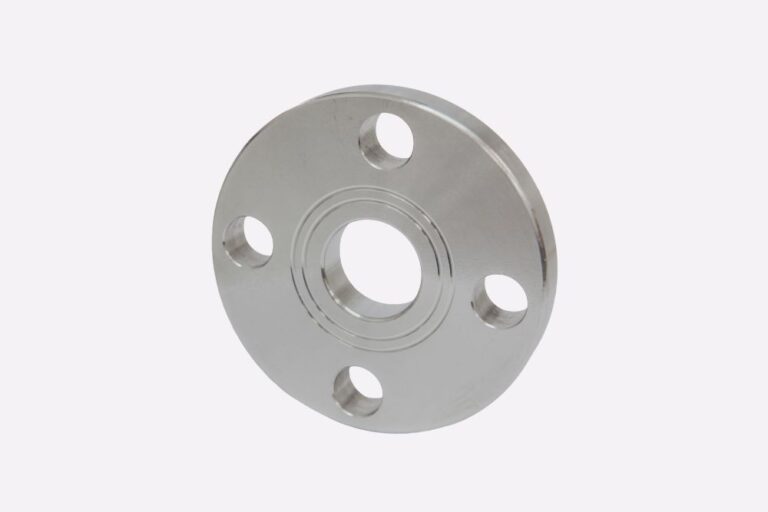
Nickel 201 flanges are manufactured from commercially pure wrought nickel with a low carbon content, making them highly resistant to corrosion and oxidation. These flanges are designed for use in industries requiring excellent mechanical properties and superior resistance to caustic alkalis. They comply with various national and international standards such as ASTM, ASME, ANSI, DIN, and EN.
Nickel 201 Chemical Composition
| Element | Composition (%) |
|---|---|
| Nickel (Ni) | 99.0 min |
| Carbon (C) | 0.02 max |
| Iron (Fe) | 0.40 max |
| Manganese (Mn) | 0.35 max |
| Silicon (Si) | 0.35 max |
| Copper (Cu) | 0.25 max |
| Sulfur (S) | 0.01 max |
Nickel 201 Mechanical Properties
| Property | Value |
|---|---|
| Tensile Strength | 403 MPa (58.5 ksi) |
| Yield Strength (0.2% Offset) | 103 MPa (15 ksi) |
| Elongation (%) | 40 min |
| Hardness (Rockwell B) | 55 max |
Nickel 201 Physical Properties
| Property | Value |
|---|---|
| Density | 8.89 g/cm³ |
| Melting Point | 1435-1446°C (2615-2635°F) |
| Electrical Resistivity | 9.8 μΩ·cm |
| Thermal Conductivity | 73.3 W/m·K |
| Specific Heat Capacity | 0.44 J/g·K |
Possible Alternative Grades:
| Alternative Grade | Description |
|---|---|
| Nickel 200 | Similar to Nickel 201 but with a higher carbon content (0.15% max) |
| Alloy 400 | Nickel-Copper alloy with enhanced strength and corrosion resistance |
| Hastelloy C-22 | Superior corrosion resistance in harsh environments |
| Inconel 600 | High-temperature oxidation resistance |
Chemical Formula:
Chemical Formula: Ni (Pure Nickel)
Grade Specification Comparison:
| Standard | Nickel 201 Equivalent |
|---|---|
| ASTM | B564 |
| ASME | SB564 |
| UNS | N02201 |
| EN | 2.4068 |
| WERKSTOFF | 2.4068 |
Corrosion Resistance:
Nickel 201 flanges offer excellent resistance to various corrosive environments, including:
- Strong alkalis like caustic soda
- Neutral and alkaline salt solutions
- Dry and humid chlorine environments
- Hydrochloric and sulfuric acid at moderate concentrations
- Seawater and brine solutions
Heat Resistance:
Nickel 201 provides outstanding performance at high temperatures, making it suitable for applications up to 600°C (1112°F). Its low carbon content prevents embrittlement at elevated temperatures, enhancing its resistance to intergranular attack.
Heat Treatment:
Nickel 201 flanges undergo annealing to refine grain structure and enhance mechanical properties.
- Annealing Temperature: 649-871°C (1200-1600°F)
- Cooling Method: Rapid air or water quenching to retain corrosion resistance
Welding:
Nickel 201 is easily weldable using standard welding techniques such as:
- TIG (GTAW)
- MIG (GMAW)
- Shielded Metal Arc Welding (SMAW)
- Plasma Arc Welding (PAW)
Precautions:
- Use matching Nickel 201 filler metals
- Avoid contamination from iron-based materials to prevent embrittlement
- Post-weld annealing is not mandatory but may improve ductility
Fabrication:
Nickel 201 flanges are easily fabricated using:
- Cold and hot working
- Machining (requires sharp tools due to work hardening)
- Forming (good ductility allows deep drawing and spinning)
Applications:
Nickel 201 flanges are widely used in industries requiring high corrosion resistance and superior mechanical properties. Common applications include:
- Chemical Processing: Caustic soda production, acid processing, and chloralkali industries
- Marine Engineering: Seawater and brine handling equipment
- Aerospace & Defense: High-temperature and corrosive-resistant components
- Electronics & Power Generation: Battery manufacturing and electrical components
- Food Processing: Handling and storage of food-grade chemicals