
Introduction to Sour Gas Pipelines
Sour gas pipelines are engineered transmission systems designed to safely transport natural gas streams that contain acidic and highly corrosive contaminants, primarily hydrogen sulfide (H₂S) and carbon dioxide (CO₂). These contaminants fundamentally change the behavior, risk profile, and engineering requirements of a pipeline. Unlike conventional “sweet gas” pipelines, sour gas pipelines must withstand severe corrosion mechanisms, heightened safety hazards, and strict regulatory controls across their entire lifecycle.
As global energy demand expands into deeper, more complex reservoirs, sour gas production has become unavoidable. We design, specify, and operate sour gas pipelines to ensure long-term integrity, environmental protection, and human safety, even under extreme operating conditions.
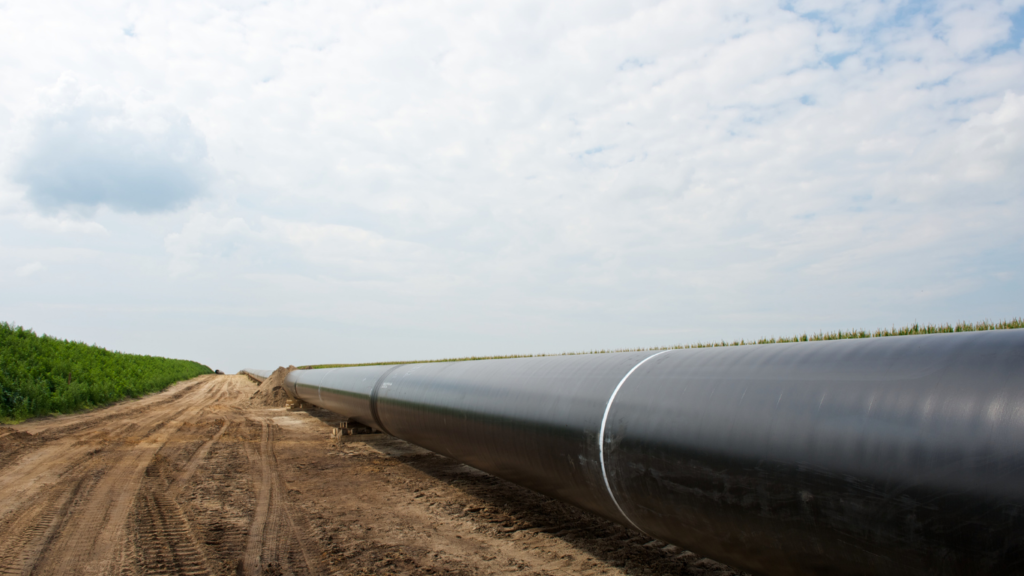
Understanding Sour Gas Composition
Hydrogen Sulfide (H₂S)
Hydrogen sulfide is a toxic, flammable, and extremely corrosive gas. Even at low concentrations, H₂S poses serious risks to personnel and infrastructure. In pipelines, it initiates sulfide stress cracking (SSC) and hydrogen-induced cracking (HIC), particularly in high-strength carbon steels.
Carbon Dioxide (CO₂)
CO₂ becomes corrosive in the presence of water, forming carbonic acid, which aggressively attacks steel surfaces. This results in uniform corrosion, pitting, and flow-accelerated metal loss if not properly mitigated.
Associated Impurities
Sour gas streams may also contain water vapor, chlorides, elemental sulfur, and mercaptans, each contributing to corrosion, fouling, or operational instability.
Why Sour Gas Pipelines Require Specialized Engineering
Sour service conditions fundamentally alter pipeline design philosophy. We do not simply upscale standard gas pipeline specifications; instead, we adopt a risk-driven, materials-focused approach that addresses chemical attack, mechanical stress, and safety exposure simultaneously.
Key differentiators include:
Enhanced material selection
Lower hardness limits
Advanced corrosion control systems
Stringent inspection and monitoring protocols
Material Selection for Sour Gas Pipelines
Carbon Steel for Sour Service
Carbon steel remains the most commonly used material, but only when manufactured and processed to meet sour service requirements. These steels must exhibit:
Controlled chemical composition
Low sulfur and phosphorus content
Fine-grain microstructure
Strict hardness limitations (typically ≤ 22 HRC)
Standards such as NACE MR0175 / ISO 15156 define acceptable material properties for sour environments.
Corrosion-Resistant Alloys (CRAs)
In high-H₂S or high-CO₂ environments, we specify CRAs to ensure durability:
Duplex and Super Duplex stainless steels
Nickel-based alloys
High-alloy austenitic stainless steels
These materials provide exceptional resistance to SSC, pitting, and localized corrosion, albeit at higher initial cost.
Clad and Lined Pipes
To balance performance and economics, we frequently adopt:
Metallurgically clad pipes
Mechanically lined pipes
These solutions combine a carbon steel structural layer with a corrosion-resistant internal alloy.
Corrosion Mechanisms in Sour Gas Pipelines
Sulfide Stress Cracking (SSC)
SSC occurs when tensile stress, hydrogen sulfide, and susceptible material coexist. Cracks initiate and propagate rapidly, often without visible warning.
Hydrogen-Induced Cracking (HIC)
HIC results from hydrogen atoms diffusing into steel, forming internal cracks parallel to the pipe surface. This is particularly dangerous as it may not immediately breach the pipe wall.
CO₂ Corrosion
Also known as sweet corrosion, CO₂ corrosion accelerates in wet gas conditions and high flow velocities, causing metal thinning and pinhole leaks.
Design Considerations for Sour Gas Pipelines
Pressure and Temperature Control
We design pipelines to operate within safe pressure-temperature envelopes, minimizing conditions that exacerbate corrosion and cracking.
Wall Thickness and Safety Factors
Sour gas pipelines typically require greater wall thickness and conservative design factors to account for corrosion allowance and crack growth tolerance.
Welding and Fabrication
Welding procedures must strictly control:
Heat input
Preheating and post-weld heat treatment (PWHT)
Weld metal chemistry and hardness
Improper welding is one of the leading causes of sour service failures.
Coatings and Corrosion Protection Systems
Internal Coatings
Internal epoxy and phenolic coatings reduce metal exposure to corrosive media, lower friction, and inhibit scale formation.
External Coatings
High-performance external coatings, such as 3LPE, 3LPP, and FBE, protect against soil corrosion and mechanical damage.
Cathodic Protection
We implement impressed current or sacrificial anode systems to prevent external electrochemical corrosion throughout the pipeline’s service life.
Operational Safety in Sour Gas Pipelines
H₂S Safety Management
Hydrogen sulfide requires zero-tolerance safety protocols, including:
Continuous gas detection systems
Emergency shutdown valves
Personal protective equipment (PPE)
Mandatory H₂S safety training
Leak Detection and Monitoring
Advanced systems such as fiber-optic sensing, acoustic monitoring, and real-time SCADA integration enable rapid identification of leaks or abnormal operating conditions.
Inspection, Testing, and Integrity Management
Non-Destructive Testing (NDT)
We employ ultrasonic testing, magnetic flux leakage, and radiography to detect:
Internal cracking
Wall loss
Weld defects
In-Line Inspection (ILI)
Smart pigging tools provide high-resolution data on corrosion, deformation, and crack initiation, supporting predictive maintenance strategies.
Risk-Based Inspection (RBI)
RBI methodologies allow us to focus inspection efforts where failure consequences and probabilities are highest, optimizing safety and cost efficiency.
Applications of Sour Gas Pipelines
Sour gas pipelines are integral to:
Upstream gas gathering systems
Onshore and offshore transmission networks
Gas processing plants
Refineries and petrochemical complexes
They enable the monetization of challenging reserves while maintaining operational integrity.