
In industrial piping systems, selecting the correct pressure rating is essential for safety, reliability and long-term performance. Flanges, valves and other piping components are commonly identified using PN ratings, such as PN16, PN25 and PN40.
But what do these numbers actually mean?
The PN designation, or Nominal Pressure, is a standardized pressure designation used with many European and international piping components. PN16, PN25 and PN40 indicate different pressure classes and are commonly encountered in water treatment, chemical processing, power generation, oil & gas and industrial piping applications.
Understanding the differences between these ratings helps engineers, procurement teams and maintenance professionals select components suitable for their operating conditions.
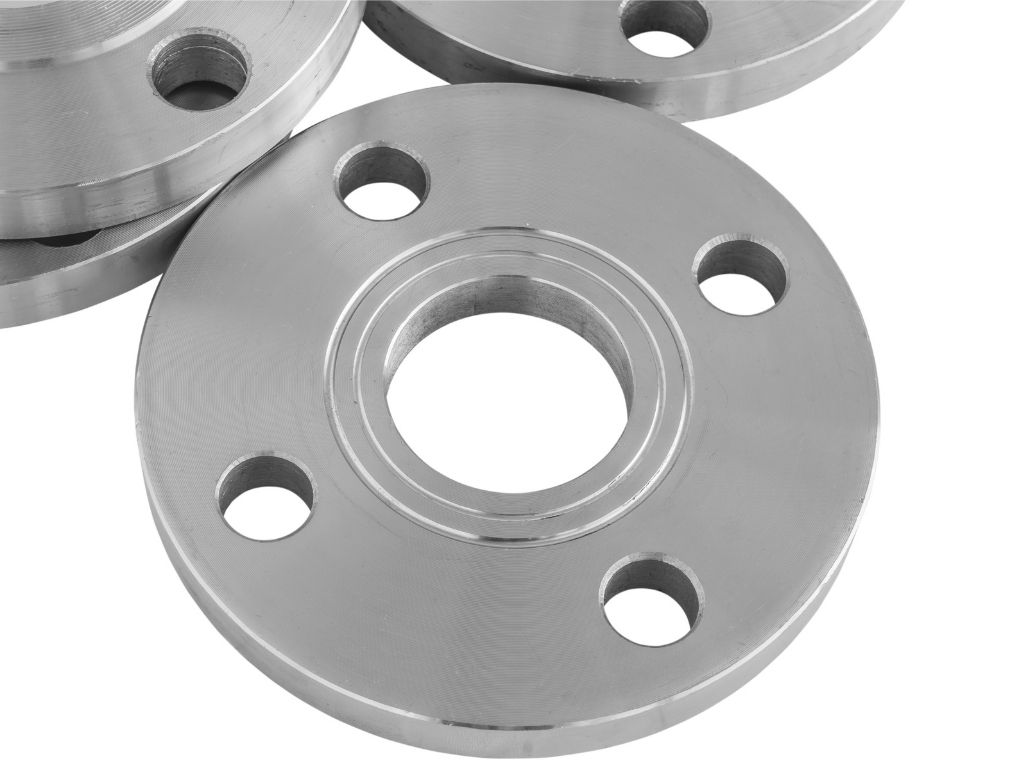
What Does PN Mean?
PN stands for Nominal Pressure.
It is normally expressed in bar and is used to designate a pressure class for compatible piping components.
| PN Rating | Nominal Pressure Designation |
|---|---|
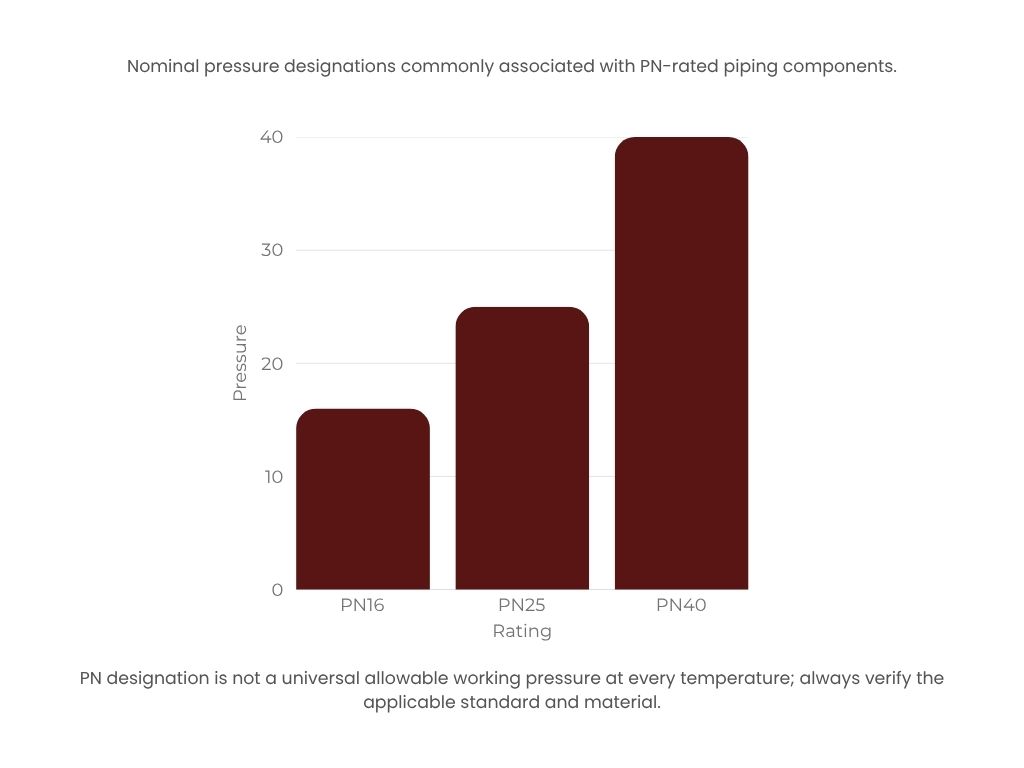
| PN16 | 16 bar |
| PN25 | 25 bar |
| PN40 | 40 bar |
The actual allowable working pressure depends on factors such as:
- Material
- Operating temperature
- Applicable standard
- Component type
- Design conditions
- Manufacturing requirements
- Pressure-temperature rating
Therefore, the PN number should be considered a pressure designation, rather than a universal maximum working pressure at every temperature.
PN16 vs PN25 vs PN40: What Is the Difference?
The primary difference between PN16, PN25 and PN40 is their pressure designation.
PN16 vs PN25 vs PN40
PN16
PN16 is commonly used for piping systems operating at moderate pressure.
Typical applications can include:
- Water distribution
- Water treatment plants
- HVAC systems
- Industrial utilities
- Compressed-air systems where the applicable pressure-temperature rating permits
- General industrial piping
PN16 components can offer a practical balance between performance, availability and cost for many moderate-pressure applications.
PN25
PN25 provides a higher nominal pressure designation than PN16.
It may be selected for applications where the pressure requirements exceed the capabilities or design margin of PN16 components.
Typical applications may include:
- Industrial process piping
- Chemical processing
- Higher-pressure water systems
- Steam and thermal systems where permitted by the applicable rating
- Industrial plants
- Process equipment connections
The appropriate material and pressure-temperature table should always be checked before selecting PN25 components.
PN40
PN40 represents a higher nominal pressure designation and is generally used where piping systems require higher pressure capability.
Applications can include:
- High-pressure industrial piping
- Chemical and petrochemical installations
- Process plants
- Power-generation systems
- High-pressure fluid services
- Industrial equipment connections
Because higher pressure ratings can require different dimensions, materials and component designs, PN40 should not simply be substituted for PN16 without checking dimensional and engineering compatibility.
PN16 vs PN25 vs PN40 Comparison
| Feature | PN16 | PN25 | PN40 |
|---|---|---|---|
| Nominal pressure designation | 16 bar | 25 bar | 40 bar |
| Pressure level | Moderate | Higher | High |
| Typical use | Utility & general industrial | Process & industrial | Higher-pressure applications |
| Component selection | Based on system requirements | Based on system requirements | Based on system requirements |
| Temperature consideration | Required | Required | Required |
| Material consideration | Required | Required | Required |
| Standard compatibility | Must be checked | Must be checked | Must be checked |
Important: PN ratings should not be used alone to determine allowable working pressure. Always refer to the relevant product standard and pressure-temperature rating for the specific material and component.
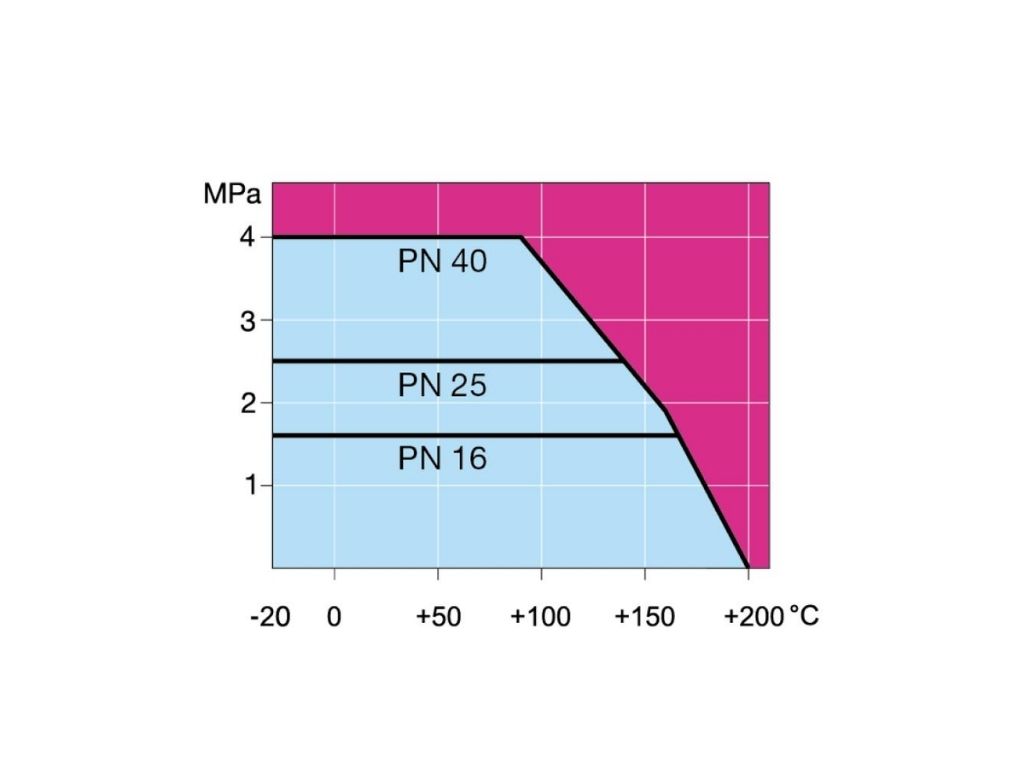
How Does Temperature Affect Pressure Rating?
One of the most important considerations when selecting a pressure-rated component is temperature.
A component that is suitable for a particular pressure at ambient temperature may have a lower allowable working pressure at elevated temperatures.
For example, a piping system may operate at:
- High pressure
- Elevated temperature
- Corrosive service
- Cyclic loading
The component must be evaluated against all applicable design conditions, not pressure alone.
This is especially important for:
- Steam systems
- Hot-water systems
- Chemical processing
- Petrochemical applications
- Power plants
- High-temperature process lines
Therefore, engineers should always consult the applicable pressure-temperature rating tables before final component selection.
PN Rating and Flanges
PN ratings are particularly important when selecting flanges.
A flange marked PN16 should generally be connected to compatible components designed for the same pressure designation and applicable dimensional standard.
For example:
PN16 flange → compatible PN16 flange/valve connection
Likewise:
PN25 flange → compatible PN25 system components
and
PN40 flange → compatible PN40 system components
However, pressure rating is only one part of flange selection.
Engineers should also verify:
- Nominal diameter (DN)
- Flange type
- Facing
- Bolt-hole pattern
- Outside diameter
- Bolt-hole diameter
- Number of bolt holes
- Flange thickness
- Material
- Applicable standard
- Pressure-temperature rating
PN16, PN25 and PN40 Flange Dimensions
One common misconception is that PN16, PN25 and PN40 flanges with the same DN will necessarily have identical dimensions.
They may differ depending on the applicable standard and DN range.
For European-standard flanges, EN 1092-1 is an important reference for steel flanges.
The relevant dimensional requirements can include:
- Outside diameter
- Bolt circle diameter
- Number of bolt holes
- Bolt-hole diameter
- Flange thickness
- Raised-face dimensions
- Bore dimensions
Therefore, before ordering a replacement flange, it is important to specify the DN + PN rating + flange type + material + applicable standard.
Can PN16 Be Replaced With PN25 or PN40?
Not automatically.
A higher PN designation does not mean that the component can always be substituted directly into an existing system.
Before replacing a PN16 component with PN25 or PN40, check:
1. Dimensions
The flange dimensions and bolt-hole configuration must be compatible.
2. Pressure Requirements
The new component must satisfy the actual design pressure.
3. Temperature
The pressure-temperature rating must be suitable for the operating temperature.
4. Material
The material must be appropriate for the fluid, temperature and operating environment.
5. Standards
The components should comply with the required dimensional and material standards.
6. Equipment Compatibility
Valves, pumps, pipes, fittings and other connected components must be considered as part of the complete system.
Why Correct Pressure Rating Matters
Selecting the correct pressure class is important for both safety and system reliability.
Using a component with an unsuitable pressure rating can increase the risk of:
- Leakage
- Flange failure
- Component deformation
- Premature equipment failure
- Unplanned shutdowns
- Safety incidents
For critical industrial systems, pressure selection should therefore be based on engineering calculations, applicable standards and the manufacturer’s certified data.
How to Choose Between PN16, PN25 and PN40
When selecting a pressure-rated flange or piping component, follow a structured approach.
Step 1 — Determine Design Pressure
Identify the maximum pressure that the piping system is designed to withstand.
Step 2 — Determine Operating Temperature
Establish the minimum and maximum operating temperatures.
Step 3 — Identify the Fluid
Consider whether the system carries:
- Water
- Steam
- Oil
- Gas
- Chemicals
- Corrosive fluids
- Other process media
Step 4 — Select the Material
Choose a material suitable for the pressure, temperature and service environment.
Examples may include:
- Carbon steel
- Stainless steel
- Alloy steel
- Low-temperature carbon steel
Step 5 — Check the Standard
Confirm the required dimensional and material standards.
Step 6 — Verify Pressure-Temperature Rating
Check the applicable manufacturer’s or standard’s pressure-temperature rating.
Step 7 — Confirm Connection Compatibility
Ensure that the flange, valve, pipe and fitting dimensions are compatible.
PN16 vs PN25 vs PN40: Which One Should You Choose?
There is no single PN rating that is best for every application.
The correct selection depends on the design pressure, temperature, material, fluid service, applicable standard and system requirements.
As a simplified guide:
PN16
Suitable for many moderate-pressure industrial and utility applications.
PN25
Suitable where a higher pressure designation is required.
PN40
Suitable for higher-pressure applications where the complete system and component ratings support the required service conditions.
Always select the pressure rating based on the complete engineering requirements rather than choosing the highest PN rating by default.
Common Mistakes When Selecting PN-Rated Components
Mistake 1: Treating PN as the exact working pressure
PN is a nominal pressure designation. Actual allowable pressure depends on the relevant standard, material and temperature.
Mistake 2: Choosing only by DN
Two flanges with the same DN can have different PN ratings and dimensional configurations.
Mistake 3: Ignoring temperature
Pressure capability can change with operating temperature.
Mistake 4: Mixing incompatible flange dimensions
Different PN ratings may have different bolt-hole arrangements or dimensions depending on the standard and DN.
Mistake 5: Ignoring material compatibility
The pressure rating alone does not determine whether a material is suitable for a particular chemical or process fluid.
Frequently Asked Questions
PN16 is a nominal pressure designation of 16 bar, but it should not automatically be interpreted as the allowable working pressure under every temperature and material condition.
Generally, PN25 represents a higher pressure designation than PN16. However, the actual performance of a component depends on its material, design, standard and operating conditions.
Not necessarily. PN40 is a higher pressure designation, but the correct choice depends on the requirements of the piping system.
Not necessarily. Compatibility depends on DN, flange dimensions, bolt-hole pattern, facing, standard and application. The complete connection should be checked before installation.
EN 1092-1 is an important European standard for steel flanges and includes PN designations. The exact applicable standard should be confirmed for the specific product and application.
No. PN designations can be used with various piping components, depending on the applicable standards, including valves and other pressure-containing components.
Conclusion
Understanding the difference between PN16, PN25 and PN40 is essential when specifying flanges and other piping components.
While PN16, PN25 and PN40 correspond to different nominal pressure designations, the correct component selection requires more than simply comparing the numbers.
Pressure, temperature, material, fluid service, dimensions and applicable standards must all be considered.
For industrial piping projects, selecting the correct flange or fitting specification helps ensure safe operation, reliable connections and long service life.
Looking for PN16, PN25 or PN40 flanges and forged fittings?
Contact Emirerri Steel for industrial piping components manufactured and supplied according to your required specifications and applicable standards.